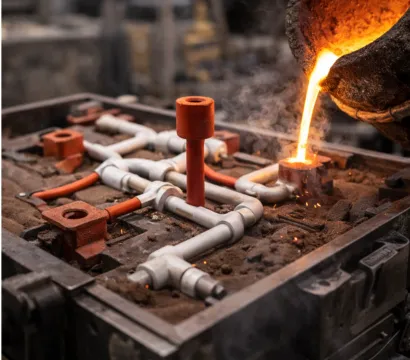
Our Approach to Mould & Gating Design
A poorly designed gating system is one of the leading causes of shrinkage porosity, cold shuts, and oxide inclusions in castings. Traditional trial-and-error tooling development is expensive and time-consuming — each failed trial costs metal, energy, and pattern modification expenses. Steel Support 24 eliminates this waste through simulation-first design methodology.
Our engineers design the complete gating system — sprue, runner, ingate, and riser — using established AFS and BICTA design rules alongside empirical chilling and modulus calculations. Every design is then validated using casting simulation software (MAGMA5 or AutoCAST-X1) to predict metal flow velocity, temperature gradients, and solidification sequence before a single pattern is cut.
The simulation output identifies potential shrinkage locations, premature solidification zones, and turbulence-prone areas. We iterate the design digitally — adjusting riser size, gate cross-section, or chiller placement — until the simulation confirms a defect-free solidification profile.
Final deliverables include dimensioned gating system drawings, riser modulus calculations, recommended chill sizes and placements, and a simulation report with solidification animations. This reduces physical trials by 60–80% and significantly lowers tooling modification costs.
Applicable to sand casting (green sand, chemically bonded), shell moulding, and gravity die casting for iron, steel, and aluminium components used in automotive, pump, valve, and heavy engineering industries.