Our Approach to Radiographic Inspection
Radiographic Testing (RT) produces a permanent visual record of a casting's internal condition — making it the preferred method for quality certification, dispute resolution, and acceptance inspection for high-value or safety-critical components. Unlike ultrasonic testing, radiography provides an intuitive image that customers and end-users can directly interpret.
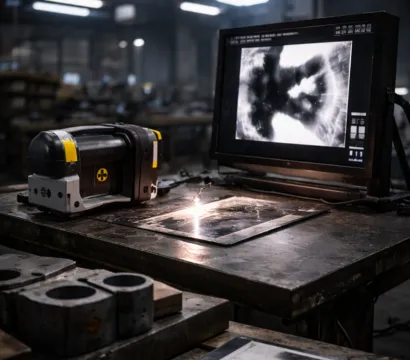
We perform both conventional film radiography and digital radiography (DR). Film radiography uses industrial X-ray film with lead screens and produces high-resolution images suitable for long-term archival. Digital radiography uses flat-panel detectors or image plates (CR), providing instant image capture and the ability to apply digital enhancement tools for improved defect visibility.
Exposure parameters — kV, mA, SFD (source-to-film distance), and exposure time — are calculated per ASTM E94, ASME Section V Article 2, EN 444, and IS 1182 to achieve the required image quality indicator (IQI / penetrameter) sensitivity. Inspection is performed by Level II and Level III certified radiographers (ASNT / PCN).
Defect types detectable include gas porosity, shrinkage (macro and micro), cold shuts, cracks, inclusions (sand, slag, metallic), and incomplete weld fusion. Reports include radiographic images, defect mapping, and accept/reject determination per ASTM E446 (steel castings) or equivalent acceptance standard.
Applicable to steel and iron castings, aluminium castings, weld joints in pressure vessels, pipelines, and structural fabrications for oil & gas, power, defence, and export-quality inspection requirements.